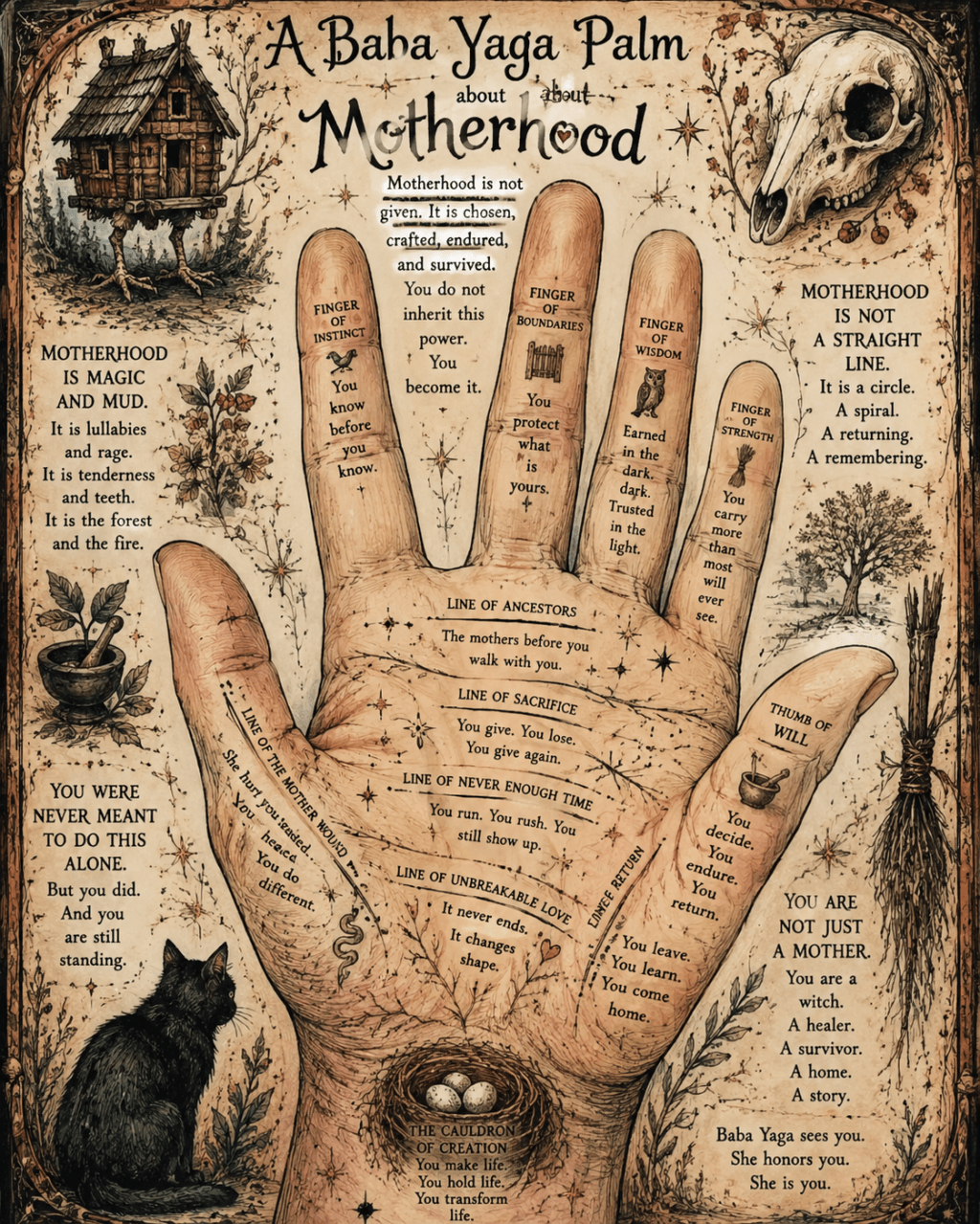
Come closer, little ember.
Hold your hands above the fire.
Do you hear it?
That crackling sound is not only burning wood.
It is every mother
who ever wondered
if she was enough.
They tell stories of mothers
as though they arrive
already knowing.
As though milk flows with wisdom.
As though lullabies
erase fear.
As though love
always knows what to do.
The old witch laughs until ravens
scatter from the pines.
“No.”
A mother
is not born.
She is forged.
She is the girl
who carried children
long before she carried babies.
She is the sister
who became another mother.
She is the friend
who remembered everyone’s birthdays,
fed every stray,
kissed scraped knees
that were never her responsibility.
The world mistakes this
for instinct.
Baba Yaga calls it practice.
Some children arrive
through certainty.
Others arrive
through terror.
Some are expected.
Some are miracles.
Some arrive
after doctors swear
they never will.
Every birth
is a doorway.
Every doorway
asks something
to stay behind.
Motherhood
is not made
of soft blankets alone.
It is blood.
Milk.
Sweat.
Sleepless nights.
Permission slips.
Tiny socks with no matching pair.
Waiting rooms.
School concerts.
Homework at the kitchen table.
Cold coffee.
Forgotten lunches.
Holding your breath
until headlights appear
in the driveway.
Again.
And again.
The old witch stirs her cauldron.
“What did you sacrifice?”
The mothers answer:
“My sleep.”
“My body.”
“My certainty.”
“My name.”
“My career.”
“My youth.”
“My marriage.”
“My peace.”
“My silence.”
The cauldron bubbles.
“And what did you gain?”
A long silence.
Then…
“A laugh that healed something in me.”
“A tiny hand searching for mine.”
“The first time they said,
‘Mom.’”
“A reason to become
someone braver.”
The forest knows
what the children never see.
How many tears
fell into dishwater.
How many apologies
were whispered
after bedroom doors closed.
How many times
their mother stood in the shower
just long enough
to gather herself
before returning
to everyone else.
Listen carefully.
Even Baba Yaga,
keeper of bones,
collector of endings,
knows this secret.
There is no perfect mother.
There are only women
who keep choosing
to return.
After the shouting.
After the mistakes.
After the exhaustion.
After believing
they have failed.
They return.
Again.
And again.
And again.
So if you meet
an old woman
walking slowly
through the woods,
Her hands rough.
Her eyes tired.
Her heart impossibly soft—
Do not ask
whether she was
a good mother.
Ask instead,
“What storms
did you carry
so your children
might learn
to dance in the rain?”
Then sit quietly.
Because the answer
will take a lifetime
to tell.
 Baba Yaga The Wise
Leave a comment