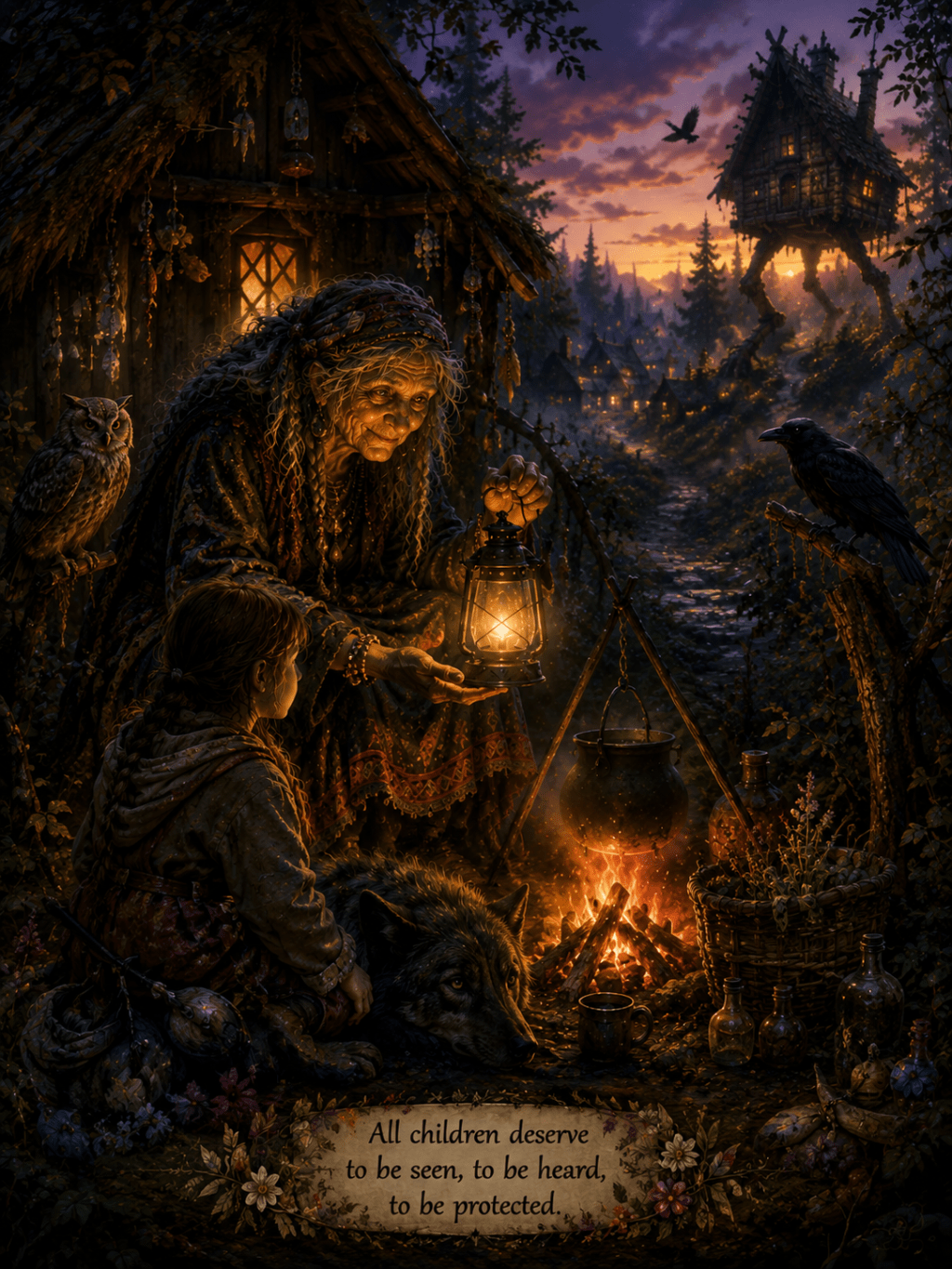
I found Baba Yaga
before dawn,
when the mist still clung
to the roots of the pines
like forgotten prayers.
She was splitting cedar,
each swing of her axe
opening the morning
with the smell of sap,
earth,
and old rain.
“I’ve seen a ghost,”
I told her.
She did not stop chopping.
“They rarely stay buried.”
“It wore a living face.”
Now she looked at me.
“Ah…
one of those.”
She drove the axe
into the stump.
The forest sighed.
“Sit.”
The smoke from her fire
tasted of cedar,
wild mint,
mushrooms after rain,
and bread
that had fed generations.
I told her everything.
About the bottles
sweating on the kitchen counter.
About the adults
who disappeared
while children pretended
to be older
than their bones.
About laughter
that curdled
into vomit.
About a young girl
whose words
fell into the room
like stones into a dark well,
speaking of death
while no grown hands
were there to catch them.
About my son—
who came home
with fear
instead of drunkenness.
Who knelt
on someone else’s floor
washing another child’s sickness
from the cracks
with trembling hands.
Who carried
more responsibility
at sixteen
than the adults
who had invited them there.
Then…
he spoke.
Not loudly.
Not cruelly.
Simply…
the truth.
The fire snapped.
A raven
shifted its feet
high above us.
“And?”
asked Baba Yaga.
“He lost his place
among them.”
The old woman
closed her eyes.
“The oldest bargain.”
“What bargain?”
She reached into the fire
with bare hands
and turned a burning log
as though it were nothing.
“Every village,
sooner or later,
asks its children
to choose.
Belonging…
or truth.”
The wind
changed direction.
“Most choose belonging.”
“Why?”
“Because exile
is older than language.”
She looked toward
the waking forest.
“Long before children
feared wolves,
they feared eating alone.”
Silence settled
between us.
The kind of silence
that only lives
among trees.
“I still wonder,”
I whispered,
“if I should have
handled it differently.”
Baba Yaga laughed.
Not unkindly.
Like branches
breaking beneath snow.
“Oh, little mother…
every woman
who has ever protected
a child
has asked herself
that question.”
She reached across the fire
and pressed her weathered hand
against my chest.
Her palm smelled
of smoke,
iron,
sage,
and time.
“You were not asked
to be perfect.
You were asked
to be awake.”
The words
entered me
like warm broth
after a long winter.
“I still hate
seeing her.”
“I know.”
“I become
the frightened girl
who was told
she was making trouble.”
“I know.”
“I still wish
someone would tell me
I wasn’t crazy.”
The old witch smiled.
“My dear…
you are waiting
for a verdict
from people
who built their houses
out of appearances.”
She pointed
toward the village.
“Their walls
are painted beautifully.
But listen.”
I listened.
Nothing.
“No birds.”
“No laughter.”
“No children.”
“Exactly.”
Then she pointed
toward the forest.
Ravens argued.
Woodpeckers hammered.
A fox slipped
through the ferns.
Somewhere,
water laughed
over stones.
“The forest
has never cared
who sat
at the popular table.
It remembers
only this—
Who shared their bread.
Who kept their word.
Who protected
the smallest voice.
Who told the truth
even when it echoed
back to them
alone.”
The fire burned low.
Ash drifted upward,
becoming stars.
Baba Yaga
lifted her lantern.
Its light
was no brighter
than a single heart.
Yet somehow
the entire forest
found its way home.
Before I left,
I asked her,
“What becomes
of the children
who lose everything
because they choose
the truth?”
The old woman smiled,
and in that smile
I saw every grandmother,
every raven,
every wolf,
every mother
who had ever stood
between innocence
and the dark.
“They become…
the ones
others trust
when the night
is deepest.”
She placed
the lantern
in my hands.
“Carry this.
One day,
another frightened child
will be looking
for the light.”
 Baba Yaga The Wise
Leave a comment