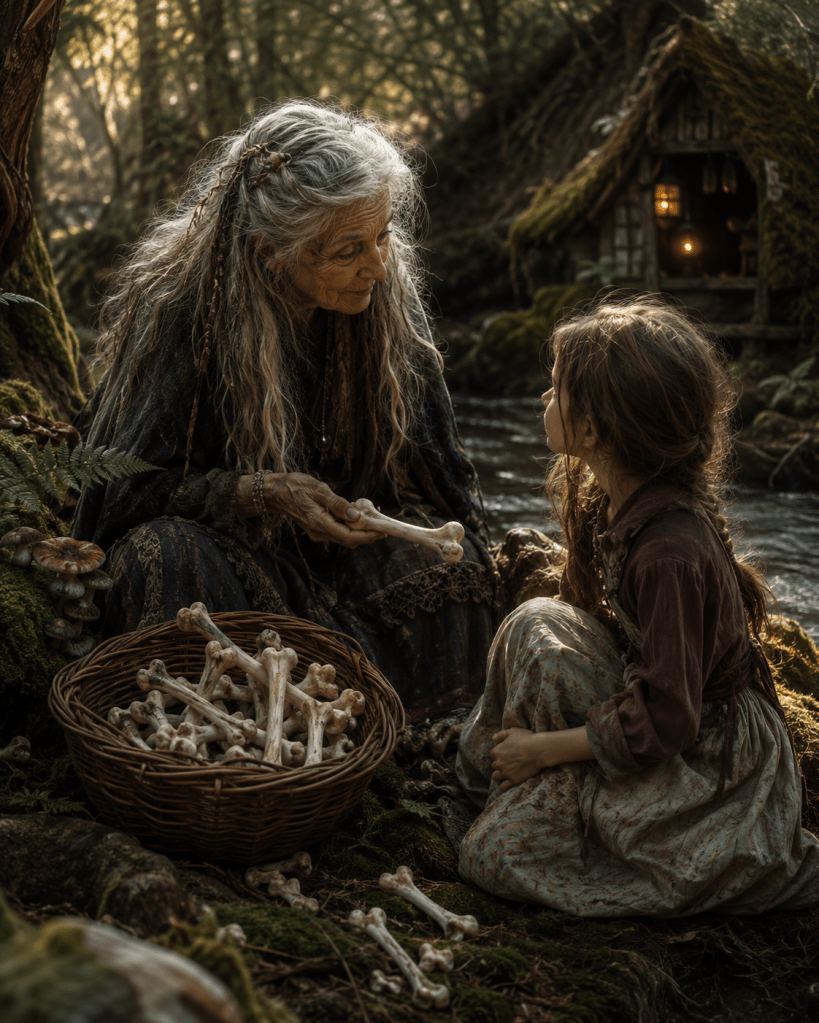
I found Baba Yaga
walking slowly
through a cedar forest
after the rain.
The air smelled of wet bark and earth,
and the ground sighed softly beneath our steps.
She carried a willow basket
on one arm.
The woven reeds creaked faintly,
damp and darkened by the weather.
It was filled with bones.
Not frightening bones.
Not the kind
wolves leave behind.
These were smooth
and pale,
worn soft
by many hands,
like river stones warmed by touch.
“What creature
did those belong to?”
I asked.
She smiled,
her eyes catching a thin thread of light
through the branches.
“Families.”
I laughed,
thinking she was joking.
She never laughed back.
We walked together
until we came
to a fallen redwood,
its great trunk
covered in emerald moss,
cool and damp,
breathing out the scent of green life.
The old witch
set down her basket
and lifted out
the smallest bone.
Her fingers were rough,
but careful,
as though the bone might remember pain.
“Once,” she said,
“there was a little girl
who grew up
in a house
where no one knew
how to speak
without shouting.”
She turned the bone
over in her hands,
its surface catching the dim forest light.
“So when she became a mother,
she whispered instead.
She promised herself
her children
would never hear yelling.”
The witch reached again
into the basket,
the bones shifting with a soft, hollow sound.
“But no one had ever taught her
how to speak
when her heart was breaking.
So she became silent.
And her children learned
that love
goes quiet
when it hurts.”
She laid the bone
gently beside the first,
nestling it into the moss.
Another came out.
“This mother
was never held
when she cried.
So she loved fiercely,
worked endlessly,
gave away
every piece of herself.
Her children learned
that love
meant exhaustion.”
Another.
“This father
grew up believing
tears were weakness.
So he built
a house of strength.
His children learned
that sorrow
must always be hidden.”
Another.
“This grandmother
was left behind.
She spent her whole life
afraid
everyone she loved
would leave.
Her children learned
to cling.
Or to leave first.”
Soon the moss
was covered
with little white bones,
their pale shapes glowing faintly
against the deep green.
Each one different.
Each one
telling the same story.
I looked at Baba Yaga.
“Did none of them
mean to do it?”
“Oh, child.”
She reached out
and tucked a fern
behind my ear,
its cool frond brushing my skin.
“Very few parents
wake each morning
wondering
how to wound
their children.
Most are simply trying
to love
with the only love
they were ever given.”
The forest
grew very still.
Even the ravens
seemed to listen,
their wings quiet in the high branches.
“So the children
carry the bones?”
“They carry
the way the bones
shape a person’s walk.”
She picked up
one last bone.
This one
had the tiniest crack,
almost invisible,
like a breath held too long.
“When does it heal?”
I asked.
Baba Yaga
held it toward the sun,
a thin beam slipping through the canopy.
The crack
filled with light,
glowing softly from within.
“It begins to heal
the moment
someone is brave enough
to stop saying,
‘This is just
how my family is…’
and starts asking,
‘Is there
a kinder way?’”
She placed the bone
back into the basket,
the wicker sighing as it settled.
The others
she left behind.
I looked at her,
confused.
“Aren’t you
taking them?”
She shook her head,
a strand of silver hair catching the breeze.
“No.
The forest will.”
Rain
would take them.
Moss
would hold them.
Time
would loosen their grip.
And one day,
someone would pass through
that quiet place
and feel only peace.
They would not know
what had been set down there.
Only that something heavy
was gone.
And somewhere,
a child would grow
unburdened,
stepping forward
without the weight
of old bones.
Learning,
without being told,
how to walk
in gentleness.
 Baba Yaga The Wise
Leave a comment