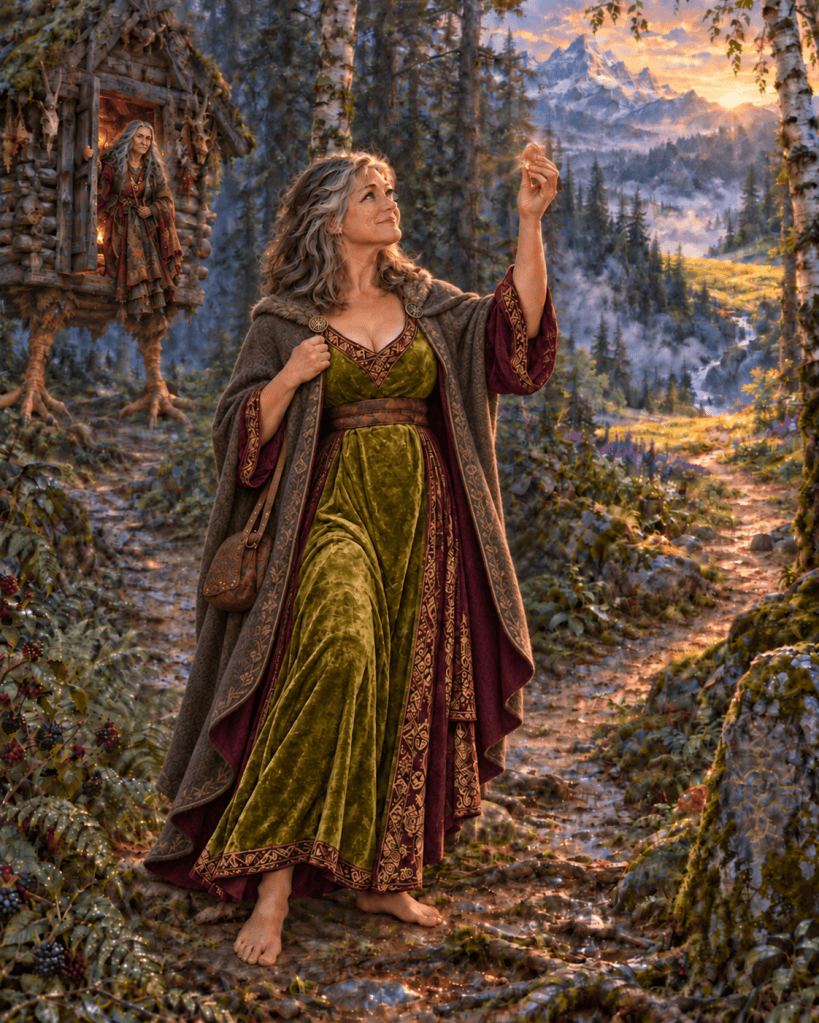
By the time the woman reached the forest, the moon had risen fat and amber above the pines.
She had been walking since morning.
Behind her lay a house in which she had spent nearly all her womanhood. Once, it had smelled of milk, woodsmoke, and babies’ hair. Three boys had thundered across its boards, slept beneath its patched quilts, and grown tall enough to duck beneath its doorways.
Now her sons were gone to homes of their own. The rooms had grown quiet.
In that quiet, the woman began to hear things she had once been too busy to notice: the carefulness of her own footsteps, the words she swallowed before speaking, the long silences sharpened and laid like knives between herself and the man beside her.
She heard her own heart asking a question she could not answer.
So she walked.
At the forest’s edge, the path narrowed. Blackberry thorns caught at her skirts. Ferns brushed wet, green fingers across her calves. The air tasted of rain and mushrooms, and beneath the soil, roots twisted together like the knuckles of buried women.
She walked until her hips ached and the soles of her feet burned.
Then she saw it.
The house stood in a clearing upon two enormous chicken legs, turning slowly beneath the moon. Bones chimed softly beneath its eaves. Smoke rose from its crooked chimney carrying the scent of cedar, onion, beeswax, and something sweetly unfamiliar.
The woman approached. The house crouched.
Its door swung open.
Inside, Baba Yaga sat beside the stove, combing burrs from her long, iron-gray hair.
“You took your time,” the old woman said.
“I did not know I was coming here.”
“Few women do.”
Baba Yaga pointed toward the table. A bowl waited there, filled with dark broth, wild mushrooms, and cream. Beside it lay a heel of black bread glistening with butter. The woman ate until warmth returned to her fingers.
“What shall I call you?” Baba Yaga asked.
The woman opened her mouth.
A wife, she nearly said. A mother. A good woman. A difficult woman. A woman who tried harder. A woman who should have been more grateful. A woman who stayed. A woman who finally left.
“I don’t know anymore,” she said.
Baba Yaga nodded, as though this were the first sensible thing she had heard all evening.
“You may sleep here tonight.”
From a carved chest, the old woman pulled thick woolen blankets, linen sheets, and a bearskin soft with age. She made a bed beside the stove and filled a pillow with dried lavender and hops.
When the woman went outside to wash, Baba Yaga reached into the pocket of her apron and removed a small red agate, rolled smooth by river water. Held to the firelight, its heart glowed like a coal beneath ash.
Baba Yaga slipped it beneath the bed.
The woman returned smelling of cold river and pine. She loosened her silvering hair, set down her dress, and climbed beneath the heavy covers.
The bed was warmer than the one she had left behind. The wool settled over her with delicious weight. Firelight traced her bare shoulder, and somewhere inside the timber, the house sighed and tucked its feathered legs beneath itself.
For the first time in many months, the woman thought she might sleep.
Then she felt it.
A small, stubborn pressure beneath her ribs.
She shifted onto her side, but the discomfort followed, finding the soft place behind her hip. She rolled onto her back, rearranged the pillow, and drew the bearskin to her chin.
It is a good bed, she told herself. You have been fed. You have been welcomed. Do not be ungrateful.
She closed her eyes. The stone pressed upward.
She folded another blanket beneath herself. For a moment, the hardness dulled, then returned—sharper against her spine.
The woman lay awake listening to Baba Yaga snore behind the curtain.
Perhaps age had made her body fragile. Perhaps the long walk had left her bruised. Perhaps every bed contained some small hardness and only foolish women expected perfect comfort.
She thought of the house behind her. She remembered music in the kitchen, a strong hand resting upon her back, three warm infants sleeping against her chest. She remembered laughter so deep it had once made her belly ache.
Then the other memories rose.
A joke that had left a bruise no one could see. An opinion dismissed before she had finished speaking. The gradual closing of doors. The way affection turned cold the moment she stepped beyond the narrow circle drawn around her.
There had been tenderness. But there had also been the stone.
For years she had piled obligations over it: forgiveness, loyalty, history, children, illness, hope. Each layer was soft and meaningful. Each had made the hardness easier to doubt.
None had made it disappear.
The woman sat up. The fire had burned down to a red pulse.
She could wake Baba Yaga and ask for another bed. She could add more blankets. She could endure until morning, offer thanks, and walk back.
Instead, she lit a candle.
One by one, she pulled away the bearskin, the blankets, and the linen. She lifted the heavy mattress and ran her hand along the floorboards.
Her fingers closed around the agate.
It was small, smooth, and surprisingly beautiful. Firelight entered its translucent body, illuminating delicate rivers of crimson, honey, and smoke.
The woman began to weep. Not because the stone was ugly, but because it was beautiful—and it had still hurt her.
Behind her, the curtain pulled back. Baba Yaga stood watching.
“You put this here,” the woman said.
“I did.”
“Why? To see if I could feel it?”
“No. I knew you would feel it.” Baba Yaga stepped closer, her bare feet silent on the pine. “I wanted to know how long you would spend explaining your pain before you permitted yourself to look beneath it.”
The woman studied the stone in her palm. “I nearly stayed there all night.”
“I know.”
“I nearly convinced myself there was nothing there.”
“I know that, too.”
Anger rose through the woman—sudden, clean, and fierce. It warmed her blood and straightened her spine.
“You had no right.”
A slow, terrifying smile moved across the old woman’s face.
“There you are,” Baba Yaga whispered.
The house unfolded its long legs and rose. Pots rattled on their hooks, the rafters groaned, and outside, startled ravens lifted from the trees.
The woman wrapped herself in the bearskin and stepped to the open door. Dawn was silvering the eastern sky.
Two paths stretched from the clearing. One led back through the forest toward the house she had left. She knew every turn of that road. The other climbed into the mountains—steep, half-hidden beneath ferns, its destination unknown.
Baba Yaga stood beside her.
“You may return if you wish,” the old woman said. “Nothing behind you has vanished merely because you discovered its shape.”
The woman looked toward the familiar road. She imagined the old rooms, the photographs, the empty beds. She felt the pull of every tender memory and every promise that had once been sincere.
Leaving had not turned love into hatred. It had only made pain impossible to keep disguising as love.
“Will the mountain path be easier?” she asked.
“No.”
“Will it lead me to someone better?”
“Perhaps. Or perhaps it will lead you to yourself. The forest is not a matchmaker.”
Despite herself, the woman laughed. The sound was low, rich, and roughened by disuse.
She looked down at the agate. “What do I do with this?”
“That depends,” said Baba Yaga. “A stone beneath your bed is torment. A stone in your hand is a tool.”
The woman closed her fingers around it.
She understood then that her instinct had never been the voice promising safety from harm; it was the quiet, persistent pressure beneath every explanation. It had not told her where to go, only refused to let her rest where she no longer belonged.
She stepped onto the mountain path.
The climb was hard. Wet stones shifted beneath her boots; brambles left thin red lines across her forearms. More than once, she stopped and looked back, watching Baba Yaga’s house grow smaller in the valley below.
By midday, she reached a high meadow where sunlight poured through the clouds in wide golden rivers. Wildflowers brushed her knees, and the air smelled of warm grass, crushed mint, and distant snow.
She removed her boots and set her feet upon the bare earth.
There was no palace waiting for her. No prince. No promise that she would never again feel lonely or uncertain.
There was only a horizon she had never seen, her own breath moving freely through her chest, and the strange, sensuous spaciousness of a life whose shape was finally hers to choose.
The woman lifted the agate toward the sun. Its red heart blazed between her fingers.
Then she slipped it into her pocket—not as proof of what she had suffered, but as a reminder of what she had refused to ignore.
Far below, Baba Yaga watched from her doorway as the traveler hesitated once more where the path divided around a stand of white birch.
This time, the woman did not look back. She placed a hand over the stone in her pocket, listened for the faint inward pressure of her own knowing, and walked on.
The forest opened before her.
 Baba Yaga The Wise
Leave a comment